The Protocol Library·A free guide + 40 books
Every protocol an engineer meets. Taught to the bit.
From UART and I²C to CAN, PCIe, USB, Wi-Fi and 5G. 760+ protocols across 40 books and 13 shelves, each taught to one standard: every field, every timing number, the maths worked out, real captures decoded, and labs you can run.
- books
- 40
- shelves
- 13
- protocols
- 760+
- pages planned
- ~17,600
Book 1, Lab 1.1: decode a real capture of “Hi!” yourself.
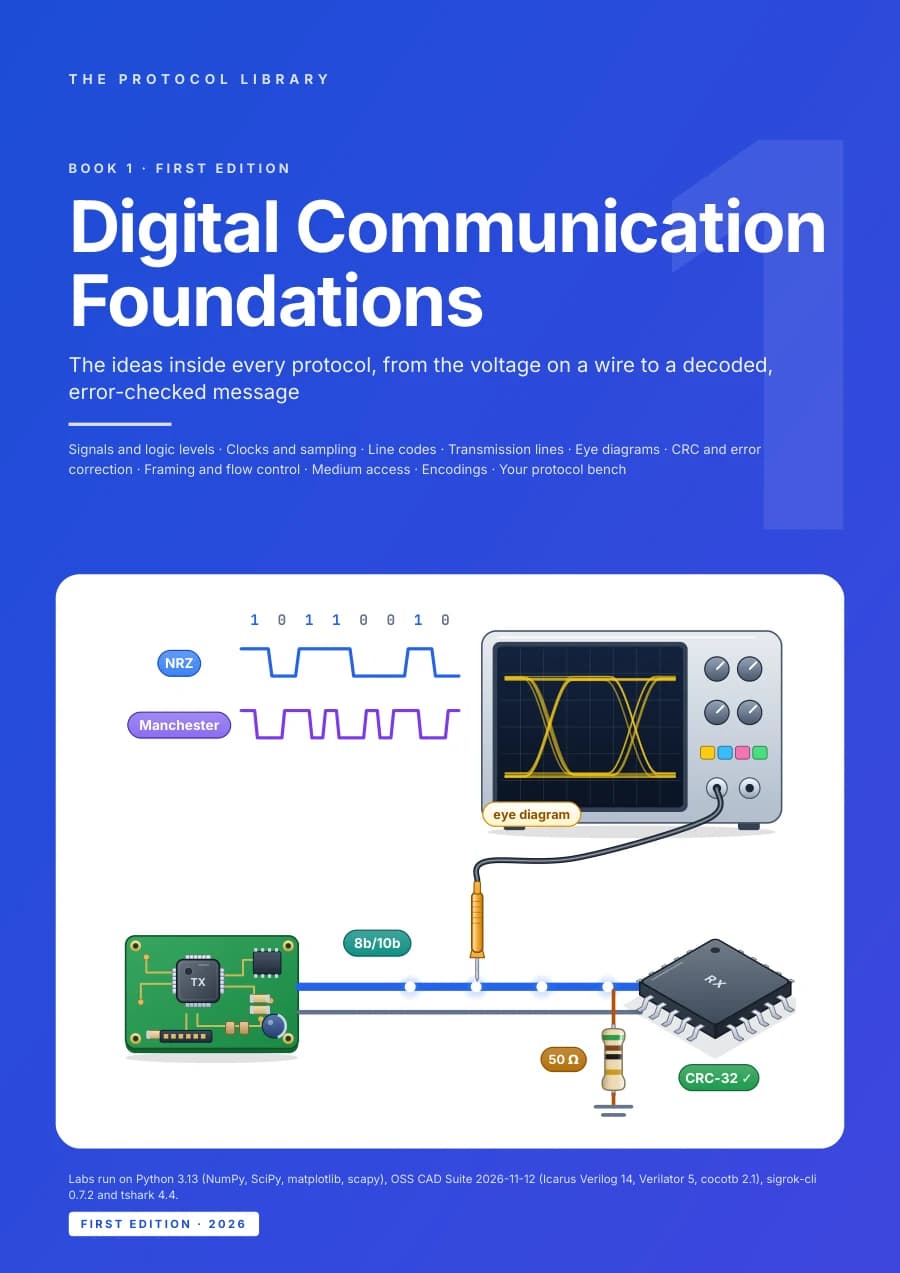
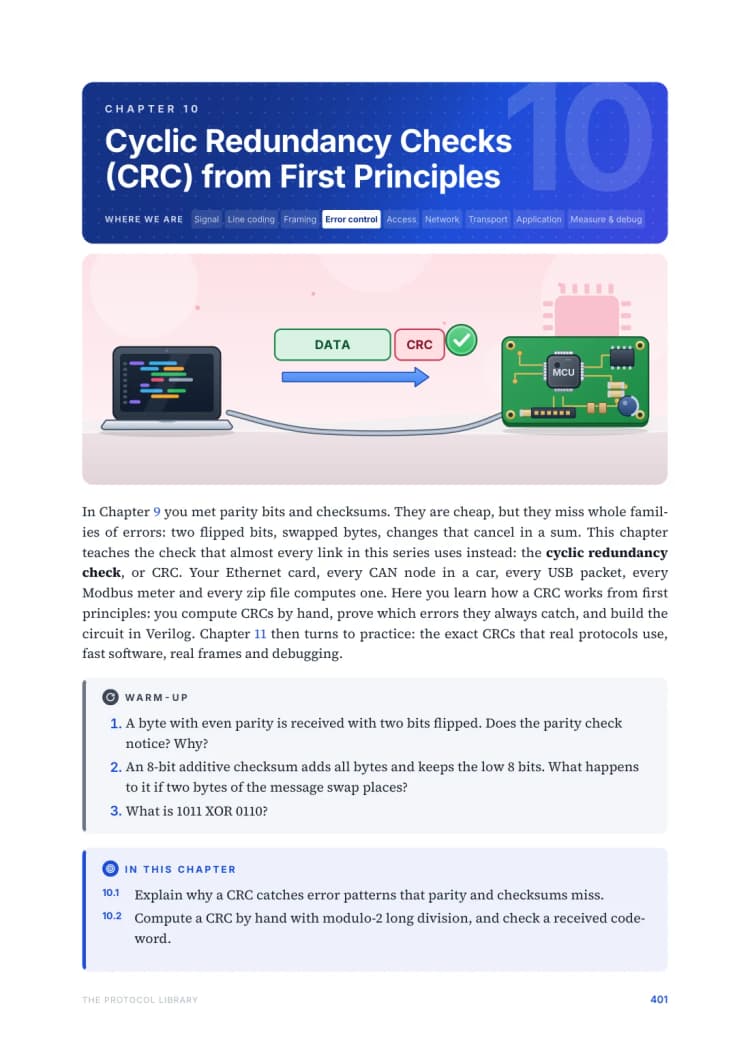
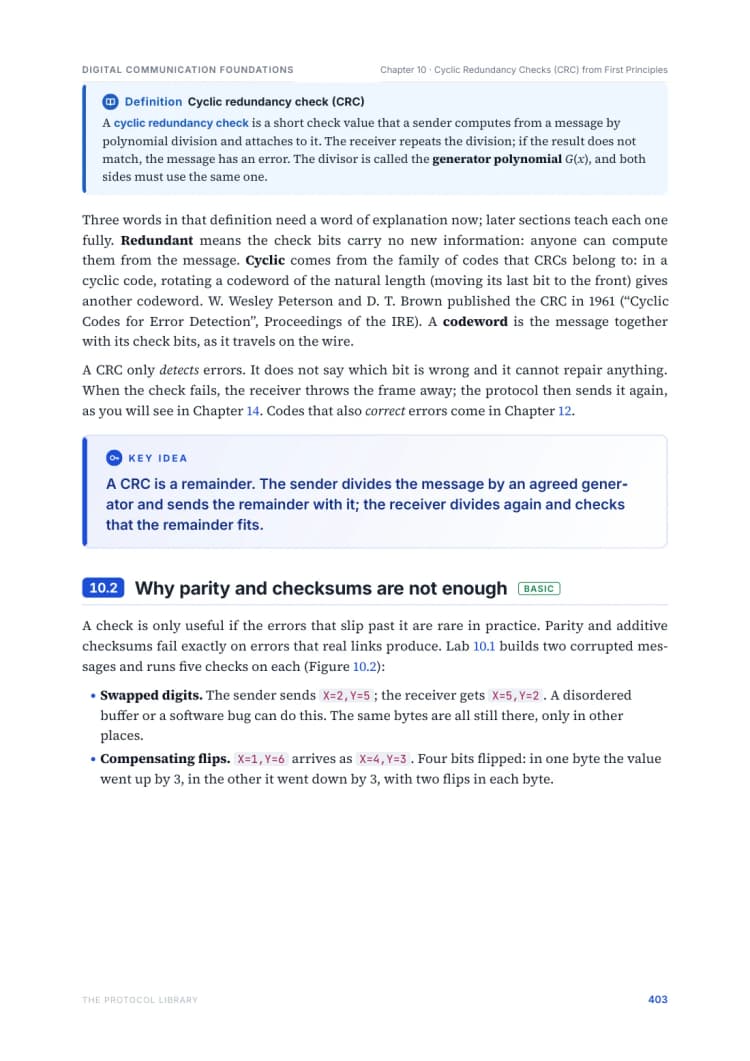
Digital Communication Foundations
Bits, clocks, line codes, signal integrity, error control, framing and access — the ideas inside every protocol
- 974
- pages
- 22
- chapters
- 502
- figures
- 71
- labs, all run
- Signals and logic levels
- Clocks and sampling
- Line codes
- Transmission lines
- Eye diagrams
- CRC and error correction
- Framing and flow control
- Medium access
- Encodings
- Your protocol bench
Instant access in Google Drive after payment. UPI, cards and net banking.
Two ways to buy
One book, or the whole library.
Buy a finished book for ₹499, or every book in the series in one payment: the finished ones now, each of the rest in the same Drive folder the day it is finished.
One book
₹499
per finished book · one payment
- Book 1, Digital Communication Foundations, out now
- Each later book on sale the day it is finished
- Instant access to that book's Drive folder
- Corrected editions land in the same folder, free
The full library
all 40 books₹4,999
one payment · every book in the series
- 1 of 40 ready today: Book 1
- The other 39 arrive in the same Drive folder, each the day it is finished
- Access to every book folder: one link for the whole series
- If a book is never finished, you can claim back its share
See the full library and the refund policy. Questions: support@adsacademy.shop
Find any protocol
Type a protocol. See which book teaches it, and how deeply.
760+ protocols, interfaces and standards, each with one home book in the series. Tier A gets several chapters, Tier B a full chapter, Tier C a compact section.
13 shelves
One library, from the voltage on a wire to 5G core networks
Every protocol lives on one shelf, in one home book. Start with the foundations, then take the shelves your work needs.
Foundations
The Protocol Map · Digital Communication Foundations
2 books · 21 protocols · available now
Board-level & embedded
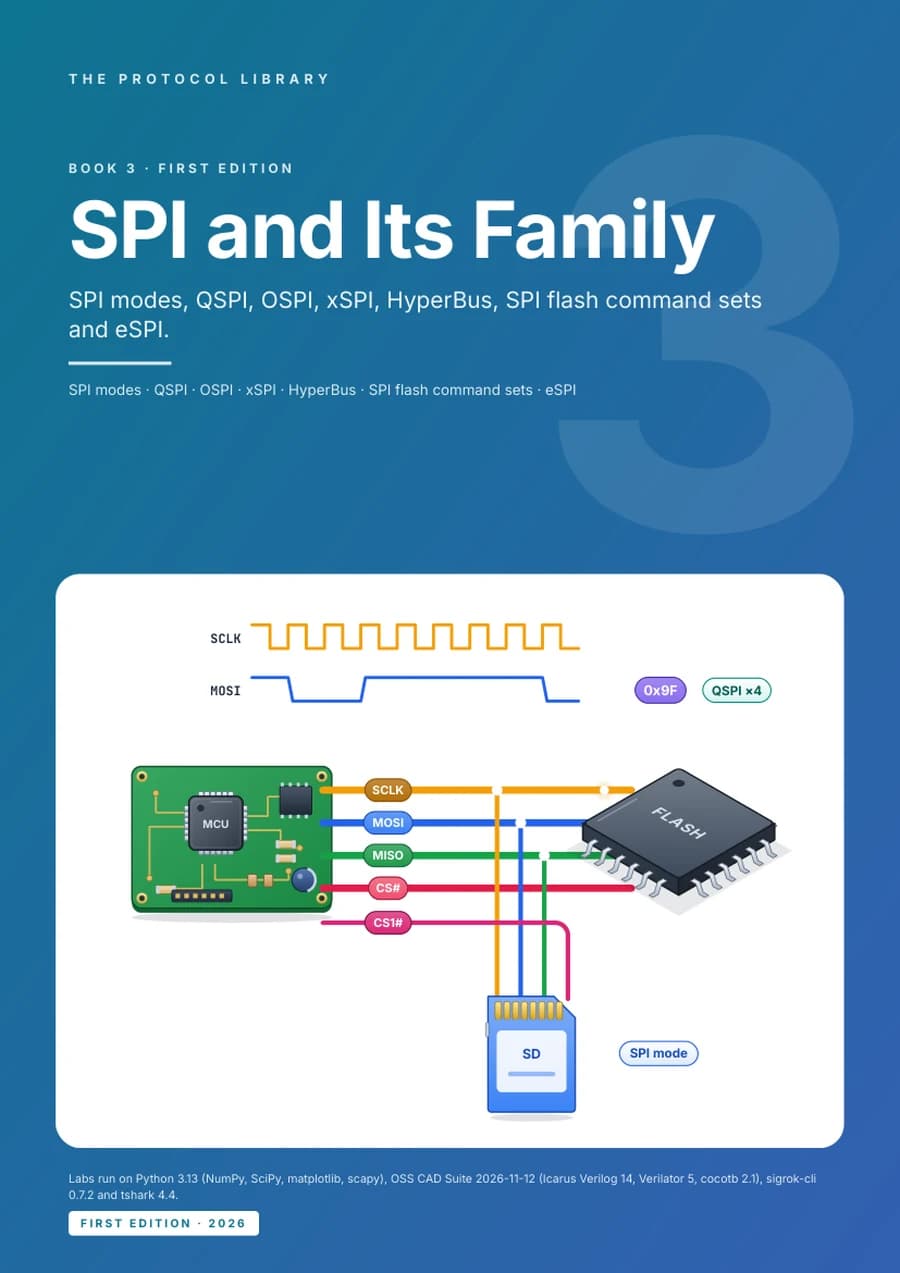
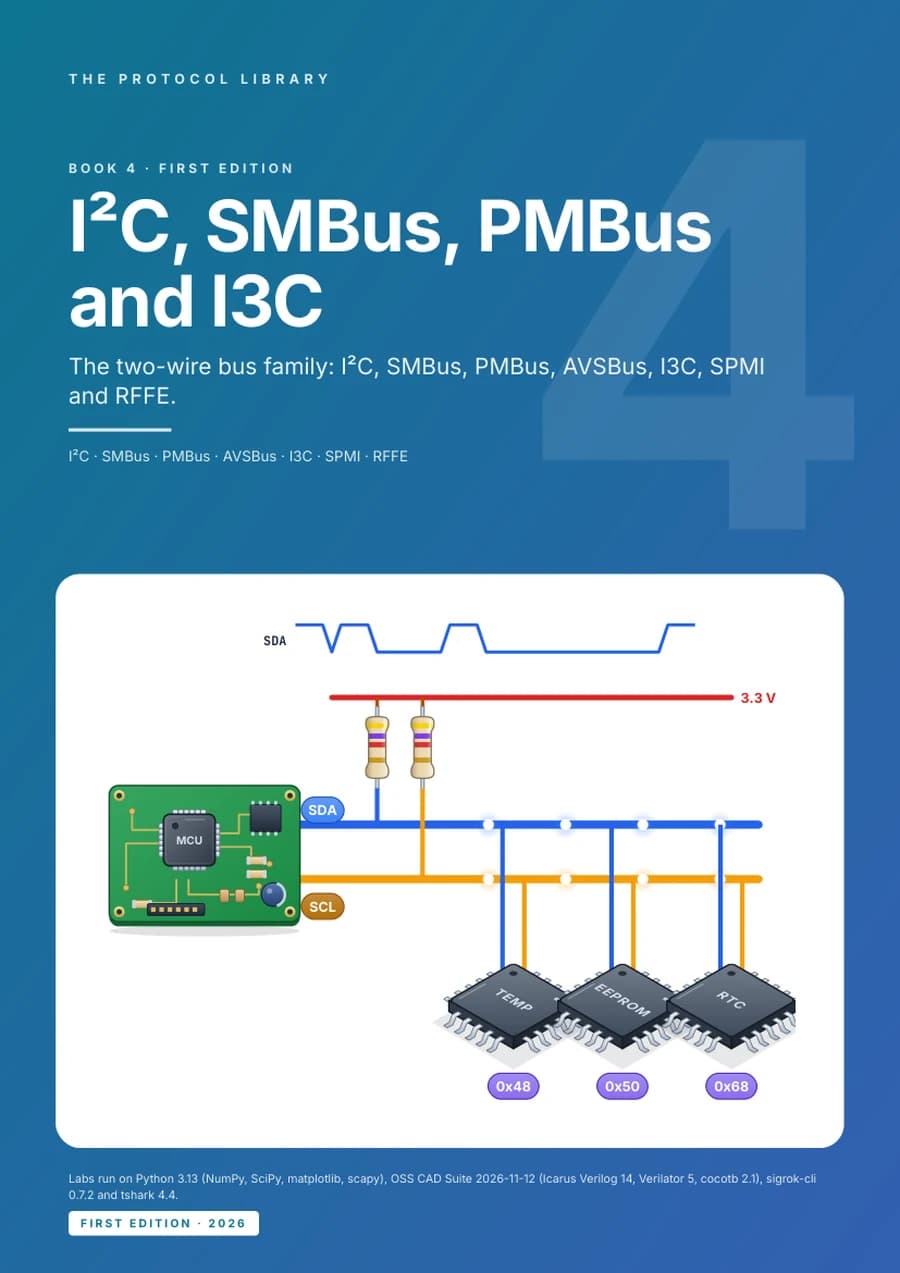
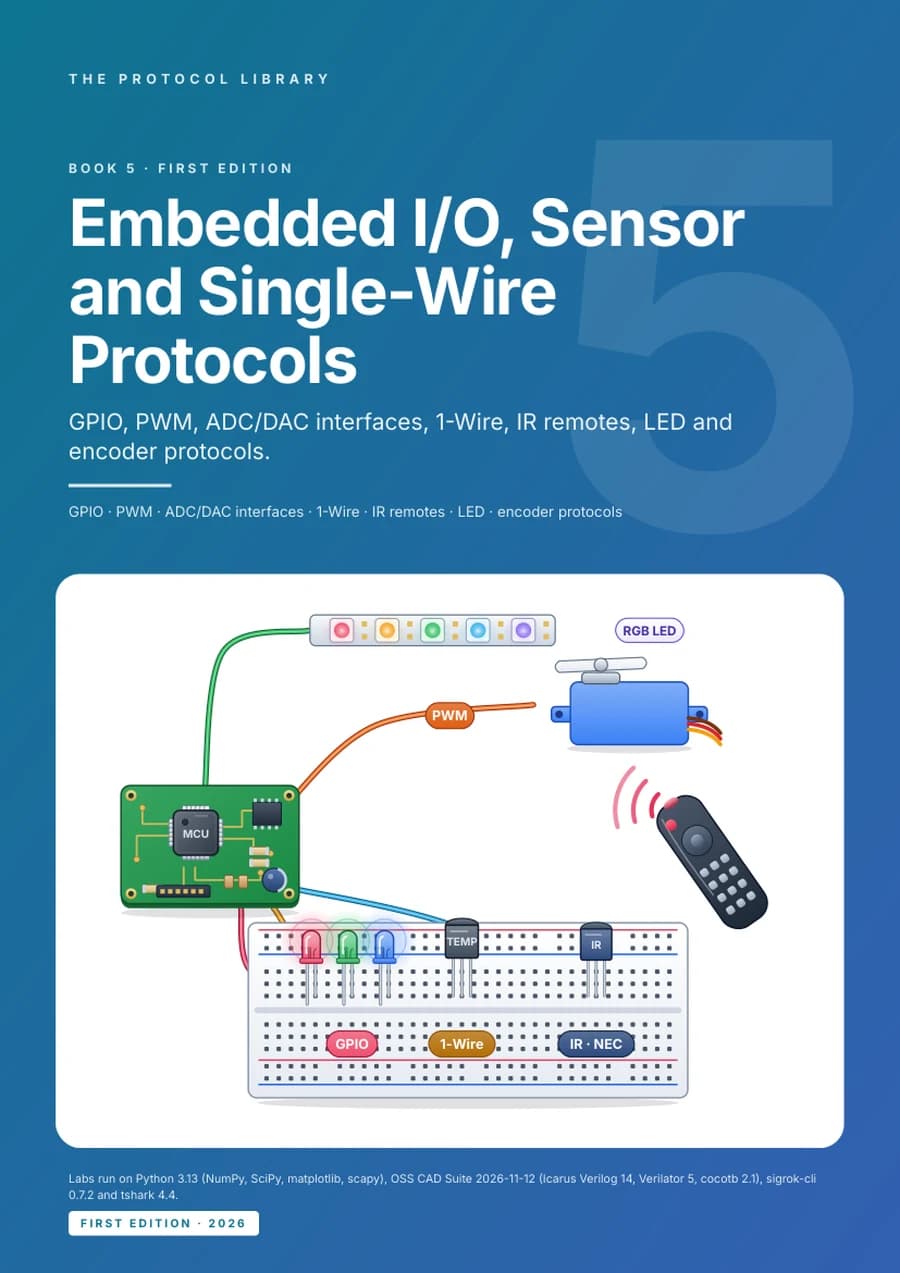
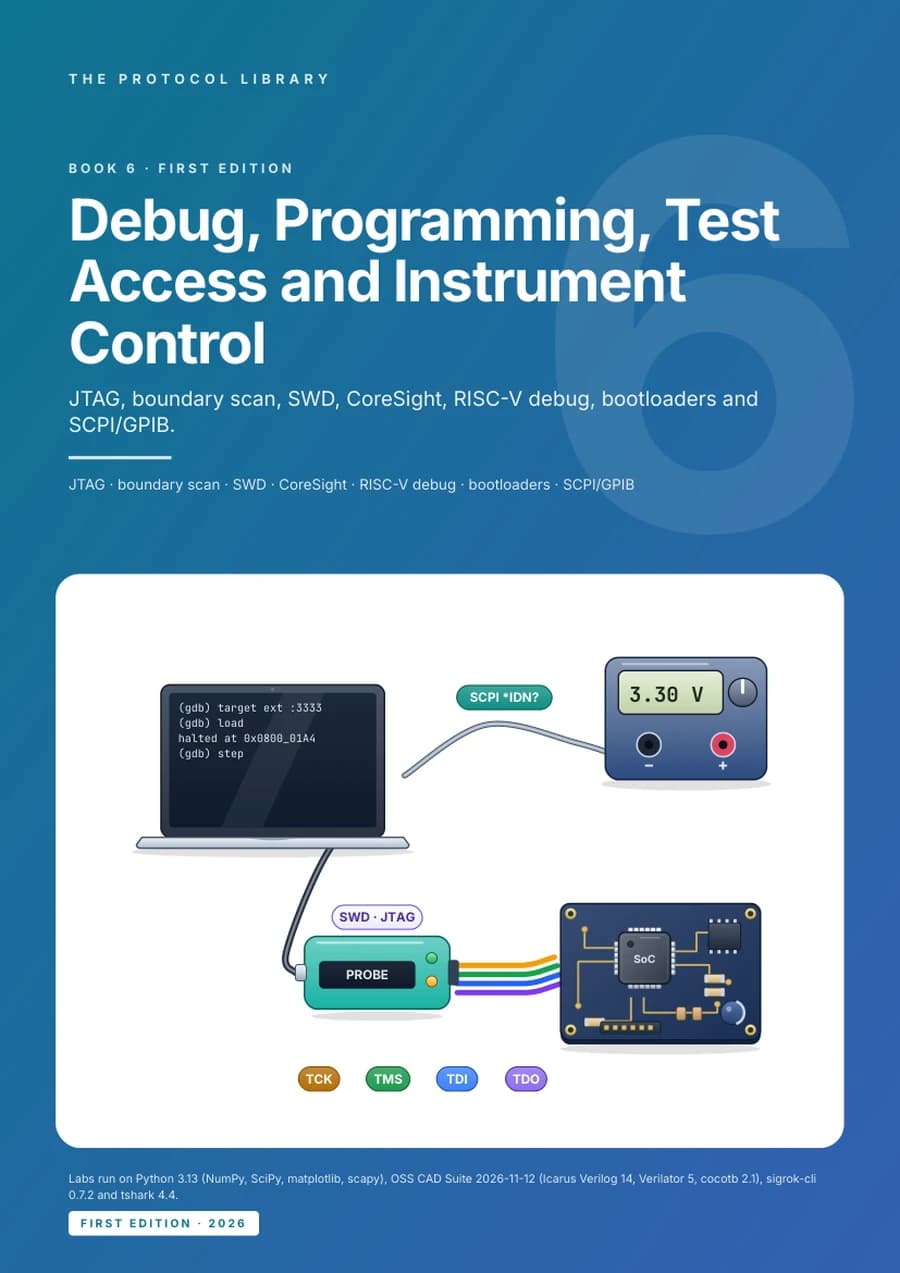
UART, RS-232, RS-422 and RS-485 · SPI and Its Family · I²C, SMBus, PMBus and I3C · Embedded I/O, Sensor and Single-Wire Protocols · Debug, Programming, Test Access and Instrument Control
5 books · 88 protocols
Vehicle
CAN, CAN FD, CAN XL and the CAN Protocol Family · LIN, FlexRay, SENT, PSI5 and Classic Vehicle Buses · Automotive Ethernet, SOME/IP, V2X and Vehicle Diagnostics
3 books · 42 protocols
Industry, buildings, energy
Industrial Fieldbuses · Industrial Ethernet, TSN and OPC UA · Building Automation, Smart Grid and Power-Line Communication
3 books · 63 protocols
Internet networking
Ethernet and LAN Switching · IPv4, IPv6 and Routing Protocols · TCP, UDP, QUIC and Transport Protocols · Internet Application Protocols · IoT Messaging: MQTT, CoAP, LwM2M, AMQP and DDS
5 books · 105 protocols
Wireless
Radio Foundations for Wireless Protocols · Wi-Fi: IEEE 802.11 from Wi-Fi 4 to Wi-Fi 7 · Bluetooth Classic and Bluetooth Low Energy · Zigbee, Thread, Matter and Low-Power Wireless · LPWAN: LoRaWAN, Sigfox, NB-IoT and LTE-M · Cellular I: From 1G to 4G LTE · Cellular II: 5G NR, 5G Core, O-RAN and 6G
7 books · 130 protocols
Optical & transport
Optical and Transport Networks
1 book · 18 protocols
Memory & storage
DRAM Interfaces: DDR, LPDDR, GDDR and HBM · Flash and Storage Interfaces
2 books · 36 protocols
Chip & system interconnect
On-Chip Buses: AMBA and Open Buses · PCI Express, CXL and Data-Centre Interconnects · USB, USB-C, USB Power Delivery and Thunderbolt · SerDes, JESD204 and Chiplet Interconnects
4 books · 65 protocols
Multimedia
Display Interfaces: HDMI, DisplayPort, MIPI DSI and LVDS · Camera, Broadcast and Professional Video · Digital Audio Interfaces
3 books · 67 protocols
Security
Communication Security Protocols
1 book · 35 protocols
Power, time, identity
Power, Battery and Charging Communication · Time, GNSS and Navigation Protocols · RFID, NFC, Smart-Card and SIM Protocols
3 books · 54 protocols
Special domains
Aerospace, Drones, Rail and Space Data Links · Medical Device Communication
2 books · 39 protocols
How every protocol is taught
One 22-part dossier, in the same order, for every protocol
You always know where to look: the passport card first, then why it exists, the wires, the bits, the frame, the transactions, the errors, the code, a real capture, the debugging playbook and a one-page cheat sheet.
- P0every tier
Protocol Passport
A one-page card: full name, who made it and when, the spec and version taught, OSI layers, topology, wires, speed, distance, node limit, duplex, addressing, error check, where you meet it and its sister protocols.
- P1every tier
Why it exists
The problem it solved, and its version timeline.
- P2every tier
Where it lives
Real systems that use it: an illustrated scene and a system diagram.
- P3
Architecture & roles
Topology, roles (controller and target, host and device…), layers.
- P4every tier
Physical layer
Voltage levels, drivers, termination and pull-ups, connectors and pinouts, cables, speed versus distance, EMC and protection.
- P5every tier
Bit-level signalling
Encoding, clocking, synchronisation and sampling, as timing diagrams.
- P6every tier
Frame and packet format
Every field, bit by bit: a bit-field figure and a table.
- P7every tier
Transactions
Complete exchanges as sequence charts; state machines.
- P8
Addressing, arbitration, access
Who may talk, when, and how collisions are resolved.
- P9
Timing & performance
Every timing parameter with real numbers; throughput, efficiency and latency worked out.
- P10every tier
Errors & recovery
Parity and CRC computed by hand, ACK/NACK, retries, error states, bus recovery.
- P11
Flow control, power, configuration
Flow control, power states, configuration and enumeration.
- P12
Versions & variants
What changed in each version, and the compatibility rules.
- P13
Hardware design
Reference schematic, part choice, layout rules, level shifting, isolation.
- P14
Implementation
Driver code (C), RTL (Verilog) for hardware-level protocols, stack code for network protocols, line by line.
- P15every tier
See it on the wire
A real capture from a lab run, decoded: analyzer view or packet dissection.
- P16
Debugging playbook
Symptom → cause → check → fix, with scope and analyzer recipes.
- P17
Security
Attacks and defences, where relevant.
- P18
Compare & choose
Against its sister protocols, with a selection guide.
- P19
Myths & mistakes
“Wrong → Why → Right” boxes.
- P20
In industry
Real chips, products and practice, with the facts checked and dated.
- P21every tier
Question bank
Graded questions with worked answers.
- P22every tier
Cheat sheet
One visual page that holds the whole protocol.
Depth tiers
Deep where it matters, compact where it doesn't
Each protocol's depth is set in the series register before writing starts, so the books spend their pages on the protocols engineers use every day.
Core
Protocols an engineer works with daily: I²C, CAN, PCIe, TCP, AXI, DDR…
- Size
- 40–100 pages (several chapters)
- Dossier
- All 22 parts
- Labs
- 2–4
- Printed Q&A
- 100–200
Important
Protocols you meet often in one field
- Size
- 15–35 pages (one chapter)
- Dossier
- All 22 parts, shorter
- Labs
- 1
- Printed Q&A
- 40–80
Specialist & legacy
Niche, historical or proprietary protocols
- Size
- 5–12 pages (a section)
- Dossier
- The core parts
- Labs
- Optional
- Printed Q&A
- 15–25
Visual-first, lab-proven
At least one figure every 1.5 pages. Every lab output is real.
The figure set every protocol gets
- 01Hero scene: where the protocol lives
- 02Passport card
- 03Topology and system diagram
- 04Physical-layer schematic and connector pinout
- 05Bit-level timing diagram, every parameter labelled
- 06Frame or packet bit-field diagram
- 07Transaction sequence chart
- 08State machine
- 09Protocol stack and layer diagram
- 10“See it on the wire”: a decoded capture from a real lab run
- 11Eye diagram, spectrum or constellation
- 12Comparison chart and debug flowchart
Desk labs on free tools
- Hardware protocols as RTL: Icarus Verilog, Verilator, cocotb
- Decoding signal captures: sigrok-cli and its protocol decoders (UART, SPI, I²C, CAN, LIN, 1-Wire, JTAG, SWD, USB, I²S…)
- Network and fieldbus traffic: tshark/Wireshark, scapy, and real open-source stacks on loopback or in network namespaces
- The CAN family: python-can virtual bus, cantools, ISO-TP
- Radio PHY: NumPy/SciPy waveform labs
- Maths and plots: Python with NumPy, SciPy and matplotlib
Bench labs that need your own boards (ESP32/STM32, a logic analyzer, a USB-CAN adapter…) are clearly marked “not run by the author”.
Blind-tested chapters
A fresh reviewer answers held-out questions from the chapter alone. Target: 95 % or better.
Every number traced
Timings, voltages and field widths are traced to the primary spec, with the section logged.
Simple English
Short sentences, one idea per paragraph, every term defined the first time it appears.
8 study paths
Your career, your reading order
The plan's recommended order for each kind of engineer. Every path starts with Book 1.
- 1Book 1Digital Communication FoundationsAVAILABLE
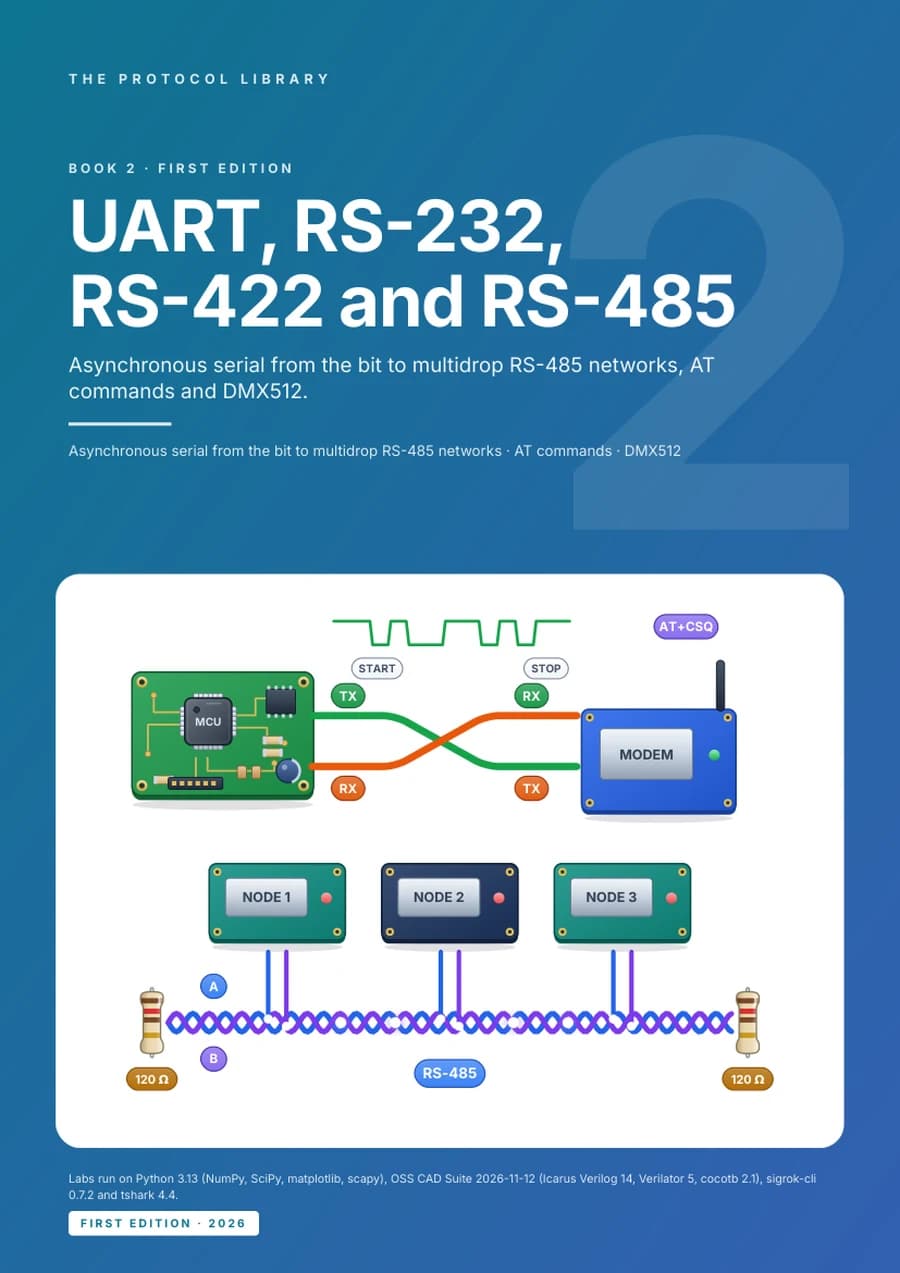
- 2Book 2UART, RS-232, RS-422 and RS-485COMING
- 3Book 3SPI and Its FamilyCOMING
- 4Book 4I²C, SMBus, PMBus and I3CCOMING
- 5Book 5Embedded I/O, Sensor and Single-Wire ProtocolsCOMING
- 6Book 6Debug, Programming, Test Access and Instrument ControlCOMING
- 7Book 30USB, USB-C, USB Power Delivery and ThunderboltCOMING
- 8Book 7CAN, CAN FD, CAN XL and the CAN Protocol FamilyCOMING
- 9Book 20Bluetooth Classic and Bluetooth Low EnergyCOMING
- 10Book 21Zigbee, Thread, Matter and Low-Power WirelessCOMING
Release roadmap
Written in three waves, essentials first
1 of 40 books is out. Single books go on sale the day their PDF is finished and tested; full-library buyers get each one in their folder that same day.
What exactly do I get?
A PDF book, shared to your Google Drive the moment you pay. Each book is ₹499. Out now: Book 1, Digital Communication Foundations (974 pages). The PDF is searchable, bookmarked chapter by chapter, and yours to read on any device.
Which books are available, and when do the others come?
1 of 40 books is out. The series is written in 3 waves, essentials first (Wave 1: 12 titles). Every book has its own page with its full contents, so you can see exactly what it will cover. Single books go on sale the day their PDF is finished and tested. The full library includes every book now, and each unfinished one appears in your Drive folder the day it is finished.
What is the full library?
Every paid book in the series for ₹4,999, one payment. You get one Google Drive folder with a folder for each book: the 1 finished book is in it the moment you pay, and each of the other 39 is added the day it is finished, with nothing more to pay. Release dates are not promised; the roadmap shows the order.
What if a book in the full library is never finished?
If the series stops, or a book has not been published within 18 months of your purchase, you can claim back that book's share of what you paid (the price divided by 40, for each book not delivered). You keep every book already delivered. Write to support@adsacademy.shop.
Who are these books for?
ECE and EEE students and graduates, embedded and hardware engineers, and VLSI, automotive, industrial, networking and telecom engineers. Book 1 starts from bits and clocks, so you need only school maths and basic digital logic. Each book opens with a 10-question readiness check that tells you if you should read an earlier book first.
How deep do the books go?
Deep enough to answer the questions a working engineer, an interviewer, an exam or a design review would ask: why the protocol exists, every rule, every field of every frame, every timing number, the maths, how to wire it, drive it and code it, how to capture and decode it, why it fails and how to fix it. For giant specifications (PCIe, USB4, 5G NR, Wi-Fi, Bluetooth, DDR5) the books teach every mechanism and number engineers use, and say exactly which spec section holds the rest, rather than copying every register table.
Do I need hardware for the labs?
No. Desk labs run on a laptop with free tools: Python, Icarus Verilog and Verilator, cocotb, sigrok and Wireshark/tshark. Every desk-lab output printed in a book comes from a real run. Bench labs for your own boards (an ESP32 or STM32, a logic analyzer, a USB-CAN adapter…) are optional and clearly marked “not run by the author”.
Is the The Protocol Map guide really free?
Yes. The Protocol Map is a free guide to the whole series: what a protocol is, where protocols live, the library map, a complete sample dossier (UART) and your free bench. Download it from its page.
Start where every protocol starts
Book 1: Digital Communication Foundations
974 pages, 71 labs, 502 figures. The ideas inside every protocol, from the voltage on a wire to a decoded, error-checked message.
Not sure yet? Read the free Start Here guide.